
Is Your HVAC Ready for the GFCI Rule? What Maryland Property Managers and Builders Need to Know
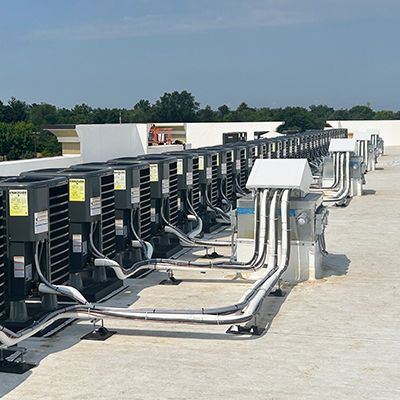
A small line in the National Electrical Code is creating big questions for anyone who manages, builds or develops residential properties in Maryland. The rule calls for GFCI protection on outdoor HVAC equipment at dwelling units, and the long-standing exemption for HVAC was set to expire on September 1, 2026.
If you oversee an apartment complex, a townhome community, a condo association or a new residential project, this affects you. One property can have dozens of condensers and heat pumps, and a single compatibility problem can repeat across every unit. Here is what the rule says, where the deadline stands, and how to plan around it.
What NEC 210.8(F) requires
Section 210.8(F) was added in the 2020 edition of the NEC. It requires GFCI protection for outdoor outlets supplied by residential branch circuits. Because it covers hard-wired equipment, it reaches the outdoor condensers and heat pumps that serve homes and apartments.
The code included a temporary exception for listed HVAC equipment, carried forward into the 2023 and 2026 editions, that delayed the requirement until September 1, 2026. The 2026 NEC also added another path: listed Class C special-purpose GFCI (SPGFCI) protection for qualifying HVAC equipment.
One point that often gets lost: 210.8(F) applies to dwelling units. Offices, retail and other purely commercial buildings generally fall outside it. Multifamily housing, townhomes and residential new construction are squarely inside it.
Why it’s a problem: nuisance tripping
GFCI protection is a good safety idea. The trouble is compatibility. Modern HVAC systems increasingly use variable-speed compressors, inverters and electronic controls, and many of them don’t work well with standard GFCI breakers.
The result is nuisance tripping: the breaker shuts the unit off even though there is no real ground fault. Industry testing has also raised concerns about conventional single-stage equipment. In the field, that looks like:
- Tenants losing heat or cooling, often during the hottest or coldest weather
- After-hours service calls that find nothing wrong with the equipment
- Repeat callbacks that frustrate residents and drive up maintenance costs
- Health and safety risks when vulnerable residents lose heat or air conditioning
On a single home, that’s a headache. Across a 200-unit property, it’s an operational problem.
Where the deadline stands
The HVAC exception was scheduled to end September 1, 2026. Ahead of that date, the industry pushed for more time:
- AHRI submitted Tentative Interim Amendment (TIA) 1924 to the NFPA, asking to extend the exception to September 1, 2028, across the 2020, 2023 and 2026 editions of the NEC. Its argument: HVAC and GFCI manufacturers need more time to make their products reliably compatible.
- ACCA urged the NFPA to approve the extension, citing AHRI’s testing.
- NAHB has raised concerns about GFCI compatibility since the rule was first introduced.
At the local level, enforcement is already uneven. In Maryland, St. Mary’s County chose to delay enforcement of 210.8(F) for listed HVAC equipment until January 1, 2027, when it will reevaluate the availability of suitable equipment. Several states are still on code editions older than 2020, which don’t include 210.8(F) at all.
The bottom line: what applies to your property depends on which code edition your county enforces and whether it has adopted local amendments. Your local authority having jurisdiction (AHJ), usually the county inspections or permits office, has the final word.
What it means for your properties and projects
For property managers and landlords. The rule mainly comes into play when you replace or add outdoor equipment and pull a permit. A replacement program that once moved smoothly could now need different breakers, different equipment selections or extra coordination with your electrician. Units that trip repeatedly also create tenant complaints and service costs that add up quickly.
For builders and developers. New construction is where enforcement bites first. Electrical plans, equipment specs and inspection schedules all need to line up. A mismatch between the HVAC equipment and the GFCI protection can mean a failed inspection, a delayed certificate of occupancy, or callbacks after residents move in.
For both. Rules that differ county by county make portfolio planning harder. A spec that passes in one jurisdiction may not in the next, so it pays to confirm requirements before each project rather than after.
Practical steps to take now
- Confirm your county’s rules. Ask your AHJ which NEC edition it enforces and whether it has amended or delayed 210.8(F) for HVAC equipment.
- Review upcoming projects. List the replacements, renovations and new builds planned for the next 12 to 18 months, especially anything permitted after January 1, 2027.
- Check equipment compatibility. Ask manufacturers and your HVAC contractor how specific models perform with GFCI protection, including the Class C SPGFCI option where your jurisdiction allows it.
- Coordinate trades early. Get your HVAC contractor and electrician aligned on breaker selection before equipment is ordered.
- Track tripping issues. Log any units that trip without a clear cause. A pattern on one model or building is worth investigating before you standardize on that equipment.
- Watch for updates. The status of the national extension request and local enforcement dates can change, so revisit your plans as decisions come in.
How Rowbel Services can help
Code changes like this are easier to handle with a partner who tracks them for you. Rowbel Services works with property managers, builders and developers to keep HVAC projects compliant, reliable and on schedule:
- Code review: We check your projects and properties against the requirements your county currently enforces.
- Equipment selection: We recommend systems and GFCI protection that meet code and keep running without nuisance trips.
- Trade coordination: We work with your electrical contractor and inspectors so installations pass the first time.
- Troubleshooting: We diagnose and fix units that keep tripping, before tenants notice.
- Capital planning: We help you plan phased replacements that fit your budget and keep units occupied and comfortable.
Planning a new build, a renovation or a 2027 capital project? Contact Rowbel Services to schedule a consultation. We’ll help you make sure your HVAC is ready for the rule, whatever your county decides.
This article reflects information available as of October 26, 2026. Code requirements and enforcement dates may change; always confirm with your local AHJ.
Sources
- AHRI, ACCA Seek Delay As HVAC GFCI Deadline Nears (ACHR News)
- ACCA Urges NFPA to Extend HVAC GFCI Exception Through 2028
- Sept. 1 Deadline Looms for Code Changes on Outdoor Outlets, GFCIs (NAHB)
- St. Mary’s County letter on NEC 210.8(F)
- TIA Proposed To Extend Expiration Date of Sec. 210.8(F) Exception No. 2 (EC&M)